Friday, July 8, 2011

4th Of July In Montana, Part 2. Putting The Wow In Pow-Wow.

Montana has a large Native American presence. Every year many pow-wows are held. The one in Arlee isn't one of the largest, but it was going on while we were there, so we went.

My day started with a search for my beloved triple shot of espresso. I figured my best bet was Polson, about six miles away on the south shore of Flathead Lake. There were several espresso stands, but none were open by 8:30, showing a basic lack of understanding of the holy purpose of the espresso industry and a shameful disregard for the needs of the espresso aficianado.

Though I didn't get my cuppa, I did get a panoramic shot of the expanse of Flathead Lake.

By the time we left for the pow-wow it was almost noon, and the espresso stand in Ronan 
was finally open, thank god. 
I don't know what a Hawaiian Latte is, but judging by the cost, they must fly them in from Kona 
on a per order basis. I wasn't willing to wait, so I settled for my usual triple shot 
at a more reasonable $1.75.


Tipis and snow-capped peaks. It's pow-wow season in Montana.

And what pow-wow would be complete without a sale on fox and coyote faces.

Not to mention raccoon penis bones. 
Before the pow-wow started, we had lunch. Fry bread, of course. 
We had them hold the penises.
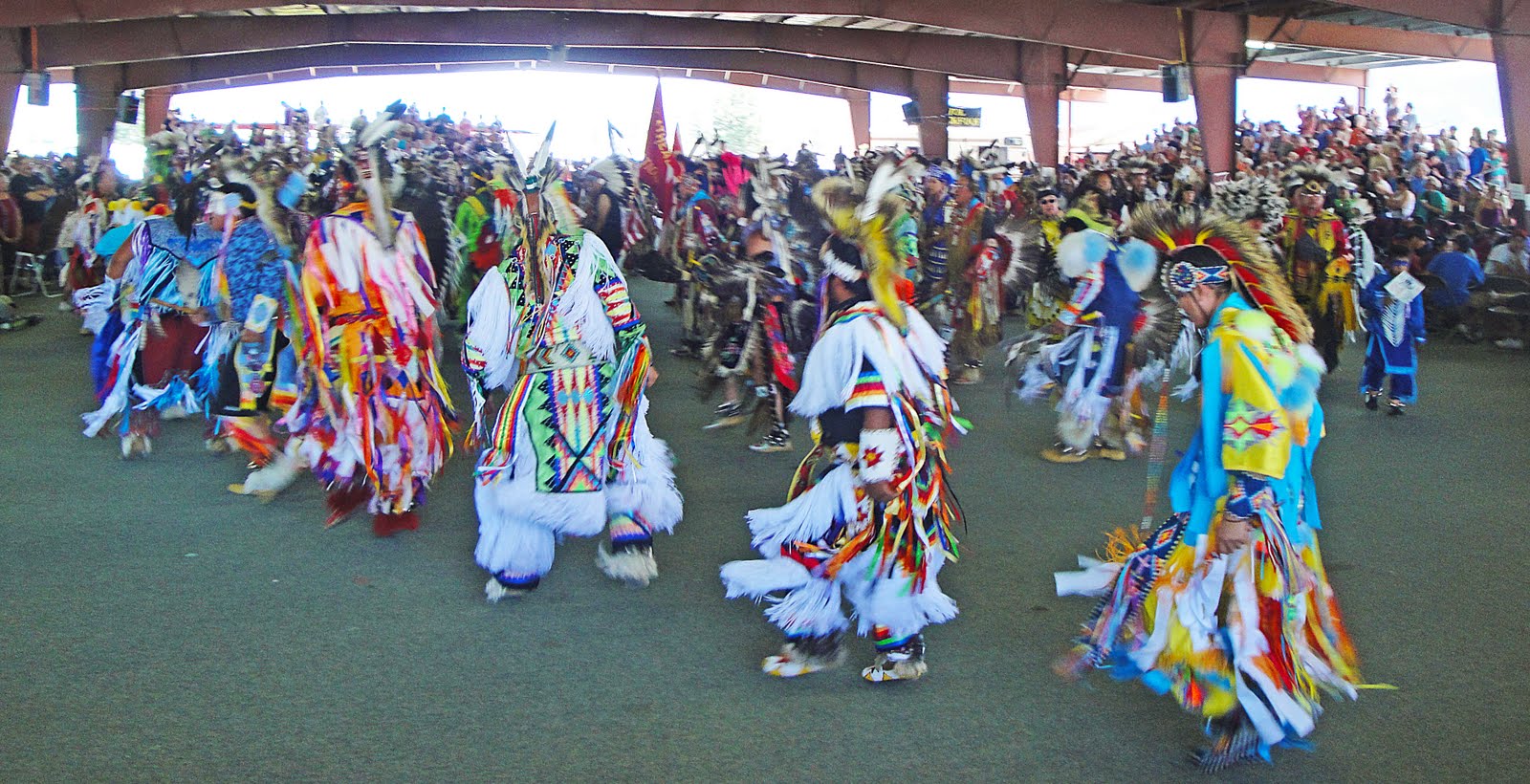
 The pow-wow started with a procession. The regalia were amazing and colorful.

I especially liked the guy in the middle in full costume except for the backwards baseball cap.

Once everyone was in, the dancing started in earnest.

 The women were generally content to promenade and chat. I love their elaborate dresses with the bells that jingle when they walk.

 The pow-wow is about family and community as well as pageantry. 
The kids were having a blast.

 "Mom and Dad took me to the pow-wow and all I got was this silly hat."

 An hour later, the promenade was still going on, the hypnotic, unchanging rhythm of the drums
driving the sweaty participants ever forward around the circle.

 But wait, who are those wild Indians in the center? Yep. O and Josie were moved to march.


 There were so many amazing faces and costumes. 
I took over a hundred-fifty shots before we left. These are a few of the best.

It was a fascinating experience, and a glimpse into a culture I know little about. Everyone seemed to be filled with pride and enjoying the closeness of community. Interestingly, Josie's landlady, who belongs to the Flathead tribe, told us that her family was boycotting the pow-wow because the tribe had laid carpeting over the previously bare earth of the dance floor, which she felt was a government plot to keep people from connecting to the earth.

And so it goes.

P.

Wednesday, July 6, 2011

4th Of July In Montana, Part 1. O And The Bikers.

Three day weekend? Time to get out of our tiny apartment and hit the road. After assessing our options, we decided that the most fun for least money spent was to visit O's sister Josie in Pablo, Montana, a mere nine hours from Boise through some of the Northwest's most spectacular scenery.

The rivers were in full flood as we headed north into the mountains. 
Since we had such a late, wet spring, everything was intensely green and lush.

We followed the Lewis and Clark trail for a while. Traffic was surprisingly sparse.

We came to a stretch of river where dozens of people were watching rafters and kayakers
negotiate a particularly gnarly set of rapids.

The rafters made it.

So did the kayakers.

Though some rolled over a couple of times first.
Standing on the bank, I could feel the incredible force of the water, as well as its chill.
Sadly, we heard from one of the spectators that a kayaker had died at that spot
just the week before. He had not been wearing a wet suit and rolled over 
into the almost freezing water.
He died in less than three minutes.

Later on, O befriended a gang of hulking bikers.

Almost everything was lush, but there were large areas of the forest 
that had been clearcut and not replanted.

I know Californians love to surf, but bringing your board to Montana shows that you're either
geographically-challenged or an incorrigible optimist.

Pablo is a small town on the Flathead Indian Reservation about six miles south 
of Flathead Lake, which is the largest freshwater lake in the western U.S.

It sits at the base of the snow-capped Mission Mountains and is surrounded
by gently rolling hills and vividly green fields. Josie had made dinner 
 for us, and we sat on her front lawn drinking beer and laughing until 
the last of the light finally faded from the sky around 11:15.

A lovely end to a beautiful day.

P.

Thursday, June 30, 2011

Carpe Diem.

Is that a carp in your boat, or are you just happy to see me?


P.

Chick Pic.

I know john already posted this on Facebook, but it's too cute not to pass on.

Luciya loves her little sister.         


P.

Wednesday, June 29, 2011

Voytek, The Alcoholic, Nazi-Fighting, Iranian Bear.

Sometimes history is way, way weirder than fiction. Case in point, this story of Voytek, an Iranian brown bear who was enlisted in the Polish Army in WWII and fought at the battle of Monte Cassino in Italy. Check out the link.

Artist's conception.
 That somewhat less sensational reality.

P.

Tuesday, June 28, 2011

When Jack Kirby Met Joe Sinnott.

Our friends at HiLoBrow are in the midst of another great series on Jack Kirby. In this series they are contrasting the original artwork that Kirby produced in his Marvel heyday, including his marginal notes to Stan Lee, with the printed pages from the comic books.

This panel from the 1960s shows the incredible synergy 
that resulted from the combination of Kirby's vividly 3-D 
composition and the impeccable linework of his inker, Joe Sinnott.

Unfortunately, much of the clarity and punch of the original art 
is irretrievably muddied by the cheesy 4/C printing and 
cheap paper stock in the final product.

Still, it was powerful enough to inspire a whole generation of artists and fans. Including me.

P.

Monday, June 27, 2011

Last Year At This Time: Heaven Or Hell?


It's very hard to believe, since it seems we've been in Boise for much longer, but on this date last year we were in Da Nang, roasting on China Beach. Looking back at our post covering that day makes me realize how far we've come in such a relatively short time. Here's the original post.

I miss our travels, but I'm enjoying this adventure, too.

P.

Friday, June 24, 2011

It's Friday, And I'm Feeling Bibsey, So I'll Commit Some Perissology.

If, like me, you deliciate in words, especially funny old words, you'll find this article illecebrous. If you're the kind of ludibrious hoddypeak who is easily jargogled, well, I can only kench.

P.

Our Bogus Friday.

Last Friday was a glorious, clear spring day with temps in the mid 70s (much like this Friday, actually), so O and I decided to skip out on our usual chores and take a short drive into the hills above Boise to the ski area called, amusingly enough, Bogus Basin.

We've had so much rain this year that usually brown hills were mostly green.

There were plenty of wildflowers. 
Thanks to Steve Smith, we now know that these are arrowleaf balsamroot, 
also called Oregon sunflowers. You're looking at downtown Boise 
with the Owyhees in the background.

Once we passed the ski area, the dirt road curved around 
to the north side of the Boise ridge, and we began to see 
patches of snow and lots of little waterfalls fed by the snowmelt.
Lining the sides of the road were patches of delicate glacier lilies (Erythronium grandiflorum).
Looking north, we saw a beautiful panorama of the back country, with the peaks of the Sawtooth Mountains in the distance.
Though the south side of Bogus was completely devoid of snow, the north slope was still covered.

We enjoyed the rocky scenery as we cruised along the empty roads, but eventually our path was blocked by a huge snowdrift that we could neither go over or around.
The wet winter left the trees covered in fluorescent green moss.
It was a lovely was to spend a Friday afternoon.

P.

Wednesday, June 22, 2011

The Girls Go Out For A Stroll.

John let the girls out to roam the back yard for the first time.

 They were a little hesitant at first.

 With Luciya's encouragement, they soon achieved free-range status.

 John certainly loves his girls!

P.

Monday, June 20, 2011

An Elephant And A Bible.

All aspiring comedians know that the key to writing a good set is developing a series of jokes that build on each other to shape a satisfying climax. Luciya has now come up with the second joke in her rapidly evolving set, a brilliant follow-on to her famous first joke.

L: Why did the elephant and the bible cwoss the road?

Her adoring audience: Why?

L: To get to the other side with the other bible.

I can't wait to hear her take on "The Aristocrats."

P.

Bun Cha For Father's Day!

John wanted bun cha for Father's Day, and that always sounds good to me, so we spent hours chopping ginger, garlic, chilies, cilantro, mint, and pork belly, getting just the right balance of fish sauce, lime juice and sugar, then grilling the seasoned and marinated pork patties to perfection. That laborious process was aided by a few rounds of classic mai tais made from scratch.

The evening was also perfect, 70s and sunny. 
The light didn't disappear until after 10:30,
but the bun cha disappeared rather more quickly.

For reference, here's the authentic Hanoi street version.

Our version is not the same, but it is delicious in the extreme. The key is getting good fish sauce. The best comes from Pho Quoc Island. You can find it at most Asian grocery stores. Even in Boise!

P.

Friday, June 17, 2011

You Say Tomato, And I Say Slavery.

As knowledgeable shoppers, we all are aware by now that the tomatoes we buy at the grocery store, especially in the winter, don't taste very much better than a comparable sphere of styrofoam. That's why many of us don't buy tomatoes in the winter, grow our own in the summer, or find stores that carry heirloom tomatoes.

Reading this article by Barry Estabrook, however, will convince you that the truth about tomatoes is worse than you think.
According to analyses conducted by the U.S. Department of Agriculture, fresh tomatoes today have 30 percent less vitamin C, 30 percent less thiamin, 19 percent less niacin, and 62 percent less calcium than they did in the 1960s. But the modern tomato does shame its 1960s counterpart in one area: It contains fourteen times as much sodium.
Okay, not good news, but the tomatoes grown in Florida also have a lot of environmental issues.
Tomatoes' wild ancestors came from the coastal deserts of northern Peru and southern Ecuador, some of the driest places on earth. When forced to struggle in the wilting humidity of Florida, tomatoes become vulnerable to all manner of fungal diseases. Hordes of voracious hoppers, beetles, and worms chomp on their roots, stems, leaves, and fruit. And although Florida's sandy soil makes for great beaches, it is devoid of plant nutrients. To get a successful crop, they pump the sand full of chemical fertilizers and can blast the plants with more than one hundred different herbicides and pesticides, including some of the most toxic in agribusiness's arsenal.
And those toxic chemicals get dumped on the ultra low-wage workers in the field and find their way into the water supply and food chain. But that's not the worst of what happens to the workers. It appears that slavery has been quietly reestablished in Florida. Not figuratively, but literally.
In the last 15 years, Florida law enforcement officials have freed more than 1,000 men and women who had been held and forced to work against their will in the fields of Florida, and that represents only the tip of the iceberg. Most instances of slavery go unreported. Workers were "sold" to crew bosses to pay off bogus debts, beaten if they didn't work, held in chains, pistol whipped, locked at night into shacks in chain-link enclosures patrolled by armed guards. Escapees who got caught were beaten or worse. 
I recommend that you read the whole article, because this is something that it's easy to do something about. In the western U.S. most of our winter tomatoes come from Mexico. I doubt that working conditions in those fields are a whole lot better, but at least tomatoes are adapted to grow there. I pledge to check the origins of the tomatoes I buy and refrain from buying any from Florida.

I hope you'll join me.

P.