Thursday, May 21, 2015

Doing Lines In Peru.


 We were feelin' good. We were flyin' high (or were about to). 


But just as we thought we couldn't get much higher... This happened.


A bad trip? No, just airsickness. It turns out that in order to give everybody on the plane the best possible view of the Nazca lines, Crazy Ivan (for those who remember "The Hunt for Red October"), our pilot, banks low and hard and often over each of the geoglyphs. It was intense even for me, but for O, it was nearly a ride on the Vomit Comet.

I'm proud to report, however, that although the barf bag was raised to her lips, she held her breakfast down.

To fully appreciate the experience, you have to imagine the entire plane (other than us, Crazy Ivan, and his copilot) filled with Japanese tourists. Every time we'd circle a geoglyph, the copilot would scream its name repeatedly in three different languages: "Mono! Mono! Mono! Saru! Saru! Saru! Monkey! Monkey! Monkey! And every time he'd say it in Japanese, all the Japanese would say "Saru! Saru!" to each other.

And boy, was the experience worth it! Oddly enough, the glyphs are quite clear to the naked eye, they were very hard to make out in the photos I took. I had to bump the contrast quite a bit to get them to show up.


The Condor


The Spider


The Monkey


The Astronaut


The Hummingbird

There are over 700 geoglyphs on the Nazca plain. Most are geometric figures. But no one really knows why they were made.


But seeing this poster makes me think it has something to do about the male energy. More proof that misterhood is powerful.


We decided to fly the Nazca lines out of Ica, the capital of southern Peru, in the middle of the southern Peruvian desert. It reminded us of the pictures we've seen of Iraq; hot after cool, coastal Lima  (low 80s), and dusty from the sand blowing off the seas of dunes that surround it.


An oasis in an ocean of sand.


We took a four-and-a-half hour bus ride down the coast from Lima to get to Ica. The landscape is much like that of Baja California.


Another oasis. Our hotel in Ica, Hotel Villa Jasmine was a lovely spot.

What we saw of Ica was not very impressive. The hotel was located in a well-guarded enclave about a ten-minute cab ride from the town center.


There were some old, pretty buildings at the edge of the dunes.


But even within the guarded area many of the houses had electrical fences on top of high walls. Some of the more upscale houses even had armed security outside.


Even the garbage is put out on raised platforms to discourage pilfering by roaming dogs.


Or it's burned in a designated dumping ground.


Still, it was a lovely time.

Next, life at 8,000 feet in Arequipa.

P.


Wednesday, May 20, 2015

Pisco Sour, Pisco Sweet.


We have fallen in love with Peru's national drink, the Pisco Sour.


Pisco is a grape brandy produced in Peru and Chile, and it is delicious by itself. The Pisco Sour mixes pisco with lime juice, sweetener, whipped egg white and a dash of bitters. Yum.

As part of our preparation for the trip, we put out messages looking for people with connections in the area. One connection we made was with Stephen Campbell, a CSL member who has lived much of his life in Peru.

We met Stephen for lunch in Lima at one of his favorite restaurants: El Amigo Pez.


We had the best, freshest fish, and the tastiest ceviche of our trip so far, and that's saying something. The fried flounder was served in a black butter sauce with lots of garlic, lime juice, and capers.The ceviche was made with a sauce called tiger's milk, full of spicy yellow chile.

We really felt a connection with Stephen. After a long lunch, he invited us to join him at his favorite pisco bar, the aptly named Pisco Bar, that evening. The Pisco Bar is owned by Stephen's good friend, Ricardo Carpio.


Ricardo is a pisco evangelist. He serves nothing but pisco in his well-stocked bar. He agreed to give us Pisco 101.


By giving us tastes of what seemed like 101 different piscos.


We all agreed that this was the winner.

He also gave us a dissertation on how pisco is made (a single distillation of a single or multiple grapes), what grapes are used, and how the altitude at which the grapes are grown and bottle aging affect the flavor. Interestingly, pisco is one of the few brandies that are never aged in containers of any organic material. No barrels, just bottle or steel.

Some fun pisco facts: Peru currently exports three times more Pisco than Chile. Peruvian Pisco won over 20 gold medals and was named the best liquor of the world in the Concours Mondial de Bruxelles 2011.

Peruvian pisco, like single-malt Scotches, is produced using only copper pot stills. Unlike the Chilean variety, Peruvian pisco is never diluted after it is distilled and enters the bottle directly at its distillation strength.


Many types of grapes are used to produce pisco, leading to a wide variation in flavor, aroma, and appearance of the liquor. Pisco must be aged for a minimum of three months in vessels of "glass, stainless steel or any other material which does not alter its physical, chemical or organic properties". Ricardo claims that five years would be a better aging period, but this is uneconomical for most producers. Hence his mission to develop an educated market for better quality pisco.

Ricardo and Stephen consider it heresy to mix pure pisco with anything else, just as it would be wrong to waste a good single-malt scotch to make a Rob Roy.


Then, probably because O and I are obvious heretics, Ricardo whipped up a couple of pisco-based cocktails for us: a Piscotini and a Pisco Manhattan. The Piscotini was a bit to sweet for my taste, though it had an interesting citrusy quality. The Manhattan, however was a perfect balance of sweet and bitter.

And that's the story of our spiritual journey in South America so far. Thanks to Stephen and Ricardo for being exceptional spirit guides.

P.

Sunday, May 17, 2015

Lima The Gray.


Lima sits on the Pacific coast a few hundred miles below the equator, so its climate never varies much. During the day it's in the low 70s, at night the mid 60s. They call it Lima the Gray because the weather is always cloudy, but it never rains (1.5" per year). The air is humid, though. Which means the plants are very, very happy and the produce is spectacular. The cold Humboldt current sweeps northward along the coast, making the waters off Peru the most prolific in the world.


That means a lot of fishy goodness in the justly famous Peruvian cuisine.

We were expecting a quaint, Latin American capital. We were not expecting a sprawling, modern city of 10 million where most of the colonial architecture has been buried beneath sleek glass and steel high rises.


From the window of our hotel in Miraflores, one of the more tranquil and charming neighborhoods in Lima.

Cultural activists were able to save some of the city's ancient treasures, however. The Huaca Pucllana is a huge adobe and clay pyramid built from seven staggered platforms. In Quechua word “pucllay,” means “game,” so Huaca Pucllana means “a place for ritual games.” It was an important ceremonial and administrative center for the Lima culture, which developed in the Peruvian Central Coast between 200 AD and 700 AD.


The complex is quite large, but it used to be much, much bigger. The rest is buried forever beneath the expanding metropolis. 


After the hot and dusty climb to the top, we descended to a little oasis of lush coolness where a couple pisco sours waited.


Much more on our new-found love for pisco sours soon.

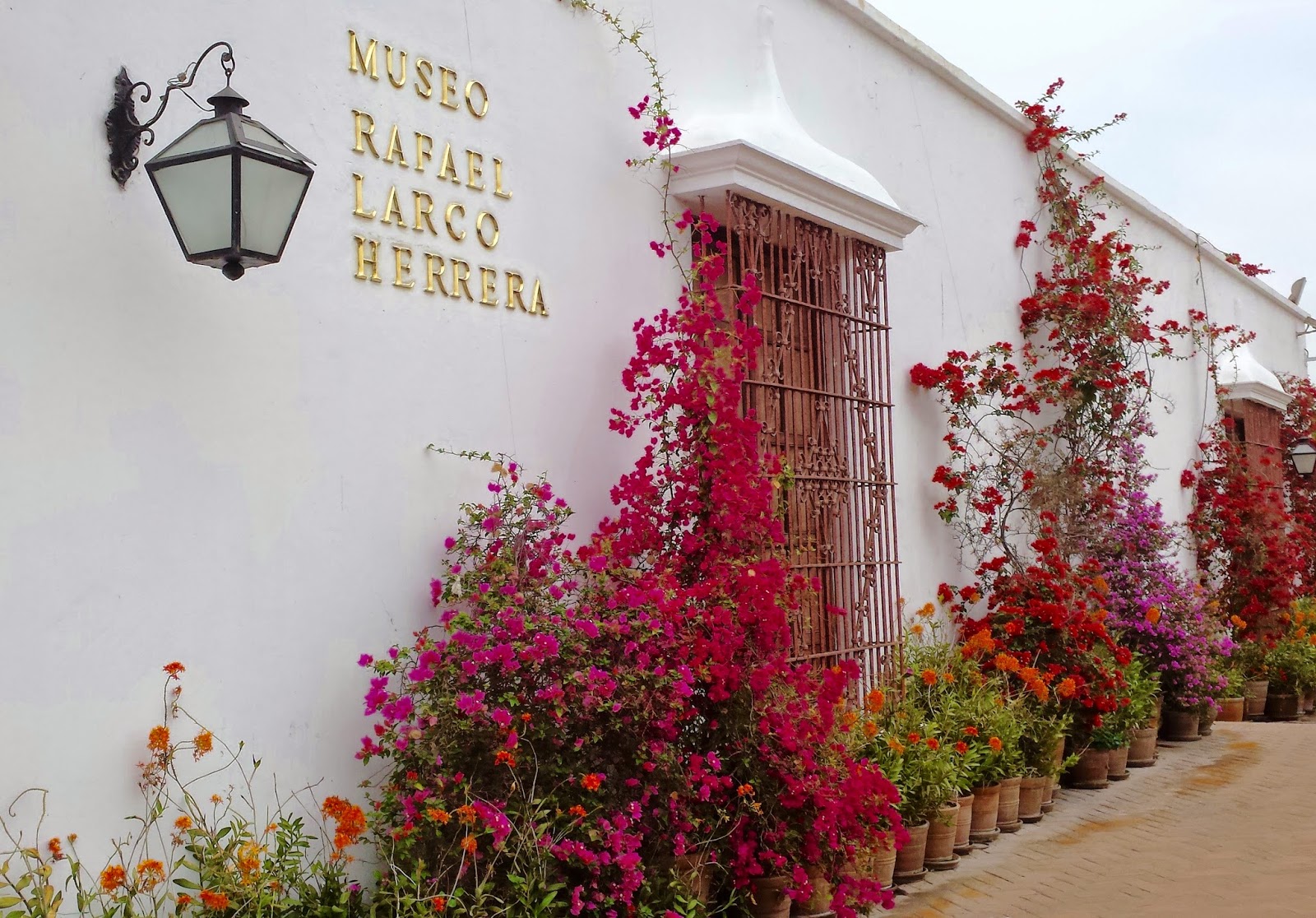
The next day, we visited the Larco Museum, a privately owned museum of pre-Columbian art. The museum is housed in an 18th-century palace built for the viceroy over the ruins of a 7th-century pre-Columbian pyramid. It has a fantastic collection spanning 4,000 years of Peruvian pre-Columbian history. It is especially known for its gallery of pre-Columbian erotic pottery from the Moche culture.


The museum grounds are incredibly colorful.


The Moche cosmology is reflected in this unique piece. The three triangles at the top represent the three worlds: the celestial world inhabited by the gods and symbolized by the green-eyed bird in the center, the terrestrial world inhabited by humans and animals symbolized by the fierce feline on the right side, and the underworld inhabited by the dead symbolized by the stylized serpent on the base.


The Moche culture valued art highly and had a caste of artists who made their living creating a huge array of ritual vessels depicting, well, just about everything.

Whimsical animal figures were very popular.


Some getting-to-know you rituals have never changed.


The erotic pottery depicts just about every possible sex act very matter-of-factly.


The Spaniards were predictably scandalized.

Also popular were pots depicting the disfigured and deformed.


For the Moche, the dead weren't gone, they were just living in their underground world where they were still available to provide the living with their wisdom.


The ceremonial costumes in silver and gold were quite elaborate. Imagine them decked with colorful feathers.


Animals were also wrought in gold and gems.


The museum was a lovely intro to Peruvian history and culture. Next on the agenda, Peru's many fusion cuisines and an extensive course on the making and savoring of pisco.

P.

Thursday, April 30, 2015

Wonderfilled.


To me, Los Angeles is wonderfilled.
Sure it's shabby, sprawling, chaotic, crowded, and often polluted, 
but if you can get beyond that, it's full of 
amazing, weird, and wonderful places and things. 

I grew up 50 miles south of LA in the sleepy little beach town of Laguna Beach. In those days Laguna was a refuge for bohemian artists and gays, a mecca for surf bums, and a home for middle and working class families. There were a few enclaves where the rich had their homes, but it wasn't necessary to have a lot of money to live there. Now, of course, Laguna is one crowded bastion of wealth; the old funky beach town has been replaced by gleaming kitsch stores and organic eateries, the thin-walled beach cottages either completely gutted and remodeled or replaced by lushly landscaped McMansions. Though there are still some legacy residents hanging on, as my mother did until she died three years ago.

In those days, Orange County was still largely orange groves, so if you wanted to go to a department store or visit an art museum, you had to drive 50 miles to the big city. We never saw that as a big deal. Southern California is the home of car culture, so when i came of age, I thought nothing of driving to LA for a movie or a concert or whatever.

So even though we were just in LA a couple days ago, when Ophelia went to visit Riverside to see her sisters, I took advantage of her absence to spend another couple days meandering about the big city.

Unlike New York or San Francisco, you can't meander through LA by foot, however. It's far too spread out for that. So I meandered by car instead, cruising up and down half-remembered streets, discovering new places, and revisiting some of the areas that were important in my life.

I started in the San Gabriel Valley. That's where my paternal grandmother used to live. Then, it was a white, middle-class neighborhood we used to visit on Thanksgiving and Christmas. Long after my grandmother died, the neighborhood became largely Latino, and more recently it has become overwhelmingly Asian. As a consequence, there are dozens of authentic Vietnamese, Chinese, and Thai restaurants there.

I was in the mood for Chinese, and LA Weekly's website had just the place for me: Chengdu Taste, number 18 on their list of LA's top 20 restaurants.


I ordered the Toothpick mutton, a Sichuan dish featuring bits of lamb marinated in a rich mix of spices (even some Indian flavors in there) then sauteed to crispy perfection and smothered with pieces of dried red chile. It was utterly delicious. And insanely hot.

 I usually eat those red peppers whole. I love the flavor and the endorphin rush. But by the end of the meal I had to shove a few of them aside lest my ears and nose start bleeding. So good!

Next stop, my Airbnb find for the night: Lucky Mansion in the heart of Koreatown.


Koreatown is on the west edge of downtown LA, just north of little Oaxaca, and it's huge. My host was Kristina Wong who, according to her blog "is a performance artist, comedian and writer who has created five solo shows and one ensemble play that have toured throughout the United States and UK."

You can catch some of her comedy stylings here:
https://www.youtube.com/user/kristinawong

Kristina recommended that I catch a show by the Upright Citizens Brigade, a comedy ensemble group like Second City. Their main show was sold out, but they had a Improv show at 5:30 for new acts to try out new material, so I booked a ticket for that.

In the meantime, I decided to wander around the neighborhood to get a feel for my surroundings. There are many great old examples of LA architecture like the Wiltern building at the corner of Wilshire and Western.


This part of LA is special to me because part of my family lived here in the early 1900s. My mother's side of the family have lived in Southern California since the 1850s and once owned a small chunk of what is now downtown LA. In fact, there's still a neighborhood north of downtown that is named Solano Canyon after my mother's great grandfather.

The World Public Library says: "The land that is now Solano Canyon was originally purchased from the City of Los Angeles by Francisco Sales de JƩsus Solano and his wife, Marƭa Rosa de las Mercedes Casanova" (my mom's great grandparents), "in 1866. Natives of Costa Rica, they built an adobe and used the land to live and work. Francisco Solano was a butcher in Sonora Town (just north of the Plaza Church along Calle Principal, or Main Street), and he moved his slaughterhouse and soap factory to the Canyon, while maintaining a corral on Main Street. The land was called Solano Ravine on maps by 1876, and the place where Francisco and Rosa lived was known as Solano CaƱon. Solano Canyon became a true community after 1888, when Alfredo Solano" (mom's great uncle), "by then a prominent surveyor and the son of Francisco Solano and Rosa Casanova, subdivided the southernmost, 16-acre parcel of Francisco's property into the 100 lots that exist today."

Alongside the dusty remnants of old Los Angeles, the new Koreatown is thriving.


Wonderfilled, indeed.

 Everybody loves Young Dong!

The comedy show was entertaining. Two sets of as-yet-undiscovered skit performers tested their material on us. Some of the skits were better than others. A couple were hilarious, but there was nothing really groundbreaking. I was impressed, however, by how professional the performers were. I'm sure I'll see them on TV in the near future.

The next day I explored a bit downtown, then headed to the beach, determined to take Pacific Coast Highway south at least to Laguna.

After walking around Santa Monica for a while, I headed for South Central LA for what LA Weekly assured me was the best southern fried chicken in LA: Jim Dandy.


Set on a rundown section of Manchester Ave near the corner of Western, about five miles east of LAX, Jim Dandy has the ambiance you'd expect for a palace of southern fried cooking.


The cashiers and cooks are protected by bulletproof glass, with a secure airlock for exchanging money and food, so you know it's good.


That's what I'm talking about. Non-greasy, perfectly crispy, juicy, and delicious chicken, well-stewed greens with lots of red chile, and tasty corn fritters dusted with powdered sugar. Yum.

With my tastebuds singing with delight, it was time for the beach. It was one of those few crystal clear days that grace LA once in a while. I had forgotten how much I miss the beach. I practically lived on the beach for the first 30 years of my life and the smell of warm sand and cool salt water still brings me an instant rush of peace.


Rather than follow PCH, I decided to circumnavigate the Palos Verdes Peninsula. The views were stunning. To the west, Catalina Island looked close enough to touch. As I rounded the peninsula to San Pedro and LA Harbor, I could clearly see the mountains that ring LA from Mt. Baldy all the way to Saddleback Mountain in Orange County.
Less spectacular was the drive from San Pedro to Long Beach, through the stink of oil refineries and docks and decaying industrial areas. My dad worked here in Wilmington all the time I was growing up, commuting everyday from the paradise of Laguna to this noisy, smelly wasteland.

And speaking of paradise: here's Laguna, the water as clear as the air. I climbed all over these rocks as a child.


A fitting end to a day of nostalgic bliss: a superb mojito at Las Brisas on the bluff above Laguna's Main Beach. O and I used to come here with friends after work to smoke cigarettes and flirt.


P.