I wanted to experience the more traditional South Sea way of life, so I booked a home stay in the remote village of Navotua on the island of Nacula (another oddity of Fijian orthography, it’s pronounced Navula), part of the Yasawa group in west Fiji.

I caught the 8:30 am ferry from Denarau harbor for the four-hour voyage to Navotua. The ferry wove its way through a dozen small islands picking up and dropping off passengers at each of the many resorts along the way.

Nacula is the furthest island from the mainland in the Yasawa group, and Navotua is at the farthest end of Nacula. So the ferry dropped me off at the Blue Lagoon Resort where Big Joe picked me up in a small boat and took me to Navotua, about a half-hour north.


It was a spectacularly lovely spot.
The people of the village were very welcoming. There are about 80 people living there, and it seemed that within a hour of my arrival, everyone knew my name. Tyma, one of the women designated to take care of visitors, showed me around and took me to a house where I was given lunch—fried fish and curried noodles with onions. It was delicious.
It was also the typical meal for the duration of my stay. The cyclone had destroyed most of the crops here as well, so no fruit or vegetables were available. But the food was tasty, and there was plenty of it. Every day, a different family hosted us for meals in their home, though the food was usually the same. I learned to say “Thank you very much" in Fijian: Vinaka vaca levu. Everyone was so hospitable that I had plenty of opportunities to practice the phrase.


Breakfast was porridge and crepes or popovers with margarine and strawberry jam washed down with instant coffee. Lunch was curried noodles with potatoes and sometimes shreds of fish, plus yellow lentil stew over rice. Dinner was usually fried fish with rice and curried noodles, though one night our hostess served some excellent curried beef with noodles. The fish was always fresh caught and delicious.

Most families have a separate cookhouse to keep the smoke and heat out of their homes.

My beachfront bungalow.

My hammock.
The first day, I was the only guest at the village, so I was really able to soak in the peace and tranquillity of this lovely place. I went snorkeling in the warm, turquoise waters of the lagoon. I lay in the hammock and watched the white, puffy clouds blown slowly across the deep blue sky. I sat in front of my little bungalow and watched the waves for hours.
There is no electricity in the village. There are no vehicles other the one small boat. No power tools, no radios, no TV. No sounds at all other than the wind and the sea, and occasionally the voices of children at play.


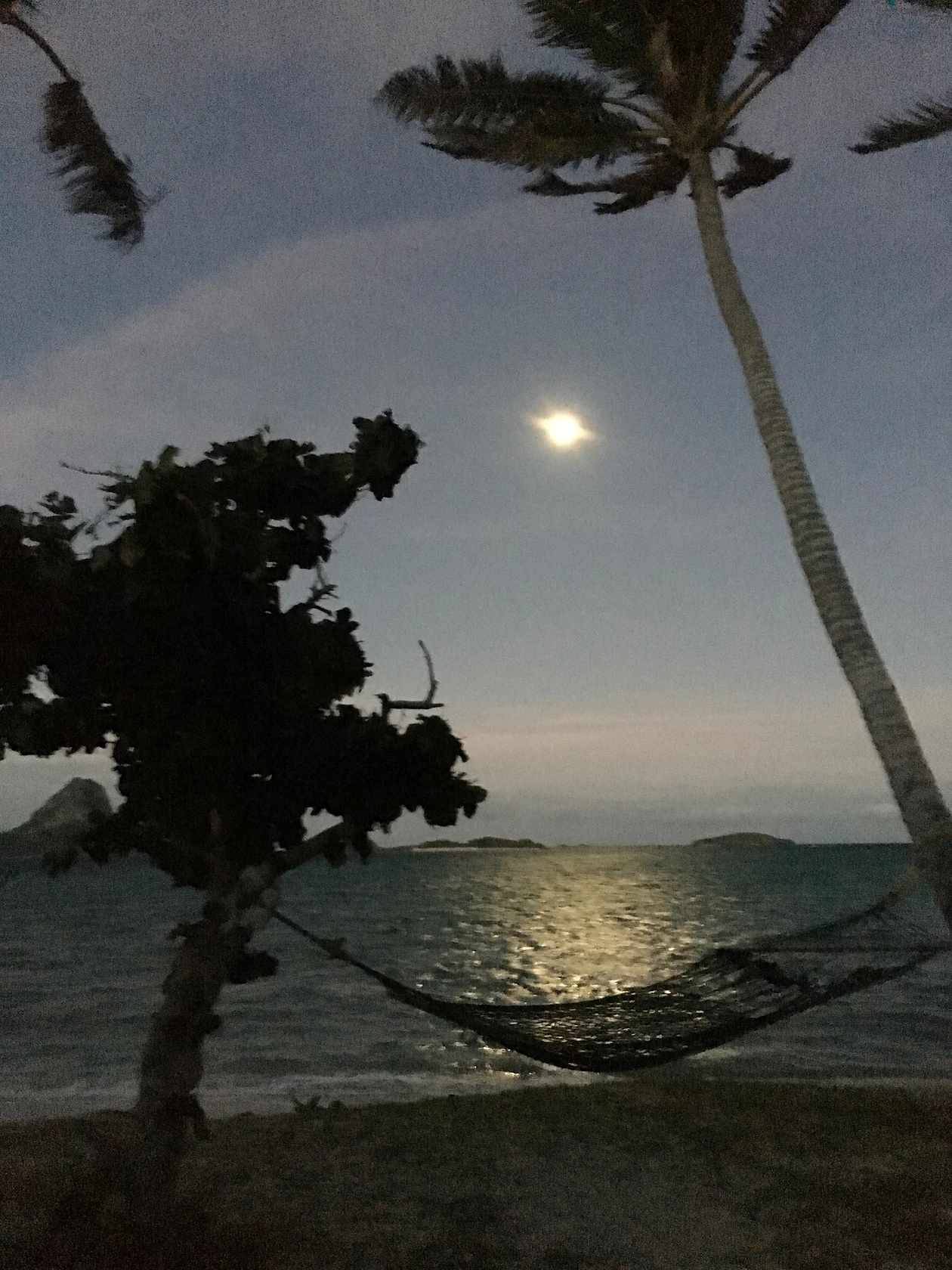
Nothing to do but watch the sun set and the moon rise.

And then the sun rise again.
Utter peace.
Broken by a loud commotion—a group of children laughing and shouting. I went over to see what was up. They had found a large fruit bat hanging in a tree. One of the men was trying to hit it with a long piece of wood, the children cheering him on. He leaped up to hit the bat, missed his footing, and tumbled to the grass as the bat dropped from the tree and flew off.
I missed getting video of the hullabaloo, but the next day the bat was back in the same tree and I was able to get this recording.
The villagers told me that fruit bat is quite a delicacy when stewed. “It tastes like chicken,” they assured me.
That night, I had to present my sevusevu to the chief. I had been told to bring a gift of kava root, which I purchased at the market in Nadi. Actually, Vino, a helpful taxi driver bought it for me. I had told him that I need to buy some, and he pointed out the he could negotiate a better price. “When they see a white person, the price goes up,” he told me. On my arrival in Navotua, Tyma had inspected the bundle of roots and pronounced it acceptable. So I was ready for the sevusevu ceremony.
It turned out that the chief was visiting another village for a funeral, so I was to present the kava bundle to the village elders instead. We all sat on the floor of a newly-built bure. I gave my bundle to Bill, the spokesman, who gave it to David, the presiding elder. He accepted it solemnly then sent it out to be ground. They asked me questions about myself, I asked them questions about the village. Then the pulverized kava was brought in, and the drink prepared. We drank and talked for an hour or so. The kava was weaker than the stuff I’d had in Kadavu, but after a while it made me very sleepy, and I called it a night.

The accommodations were basic, but comfortable.

Side-by-side outhouse and shower room.

The showerhead was so corroded that not much water came out, so I used the old bucket and dipper arrangement to wash. No hot water, of course.

The next morning, the tide had gone out, way out. I could have walked through the whole area where I had snorkeled the day before. I strolled down the beach, which was littered with bits of wood, seashells, and all manner of plastic. The tide was low enough that I could walk around the rocky point that marked the end of the beach. On the other side was a completely deserted beach. I zig-zagged up and down the strand, watching hermit crabs scuffling for dominance and bigger shells. I found a nautilus shell, completely intact and far too large for even the biggest hermit crab.
That afternoon, the boat brought two more guests from the ferry. Two saucy Aussies who had just finished spending a week in Viti Levu with their women’s group but weren’t quite ready to go home. They were a great deal of fun. They asked me not to mention their names in the blog (but you know who you are).


The next day, we took the boat across the lagoon to these dramatic limestone cliffs. The little island is riddled with caves, one of which is filled with a combination of sea and fresh water.

It was cool and refreshing to swim in. A second cave was accessible via a short swim through a narrow underwater passage. Inside it seemed totally dark at first, but as my eyes adjusted, I could see several cracks and holes in the roof of the cave that admitted a few shafts of sun like tiny spotlights. It was a magical place.


The village children were very cute and friendly. They always wanted to see the pictures I was taking.

On my last day, we went to visit the school. The kids eight and older were away at boarding school in a village on the other side of the island, so only the younger children and babies were around. We met their teacher and saw their classroom, then they sang for us.
Itsy Bitsy Spider, Twinkle, Twinkle, Little Star, The Bear Went Over The Mountain, the Fijian and Australian national anthems, and, finally, a goodbye song for me. It was too sweet, and the perfect end to a lovely stay.
Vinaka vaca levu, Navotua!
P.


